Matching the Right Horse to Every Rider: Height, Weight, Skill and Workload
Ask any experienced stable owner or head instructor what quietly makes or breaks a riding school, and they will give you the same answer: matching horses to riders.
When the pairing is right, a timid beginner steps off the mounting block with confidence, an advanced rider gets a productive schooling session, and the horse finishes the hour relaxed and sound. When the pairing is rushed or done from memory on a busy Saturday morning, the opposite happens. A light pony carries more weight than it should, a green rider is placed on a forward horse, or a dependable schoolmaster gets tacked up for its fourth heavy lesson of the day.
Most stables do not make these mistakes because they do not care. They happen because the facts needed to make a good decision—rider height, rider weight, riding experience, and how many hours each horse has already worked this week—live in different places or are never written down at all. Here is a complete, practical framework for turning horse-to-rider matching into a calm, repeatable part of your daily stable workflow.
Why guesswork at the mounting block hurts both horses and business
In a small stable with five horses and ten regular riders, the owner knows every horse's back and every rider's balance by heart. As soon as your stable grows—or when new riders book open lesson and trail-ride slots—memory stops scaling.
- Physical strain on school horses: Carrying a rider who exceeds a horse's comfortable weight range, or repeating high-intensity lessons without enough recovery time, leads to sore backs, resistance at the mounting block, and costly veterinary downtime.
- Safety and confidence for riders: A rider who feels over-horsed (or too tall for a small mount) rarely enjoys the lesson and often does not rebook.
- Awkward last-minute conversations: Asking a new adult rider about their weight in front of a group in the tack room is uncomfortable for everyone. Handling compatibility quietly during booking and horse assignment removes the embarrassment completely.
The 4 pillars of a safe horse-to-rider match
A reliable assignment system checks four concrete factors before a horse ever leaves its stall:
1. Minimum rider height and maximum rider weight
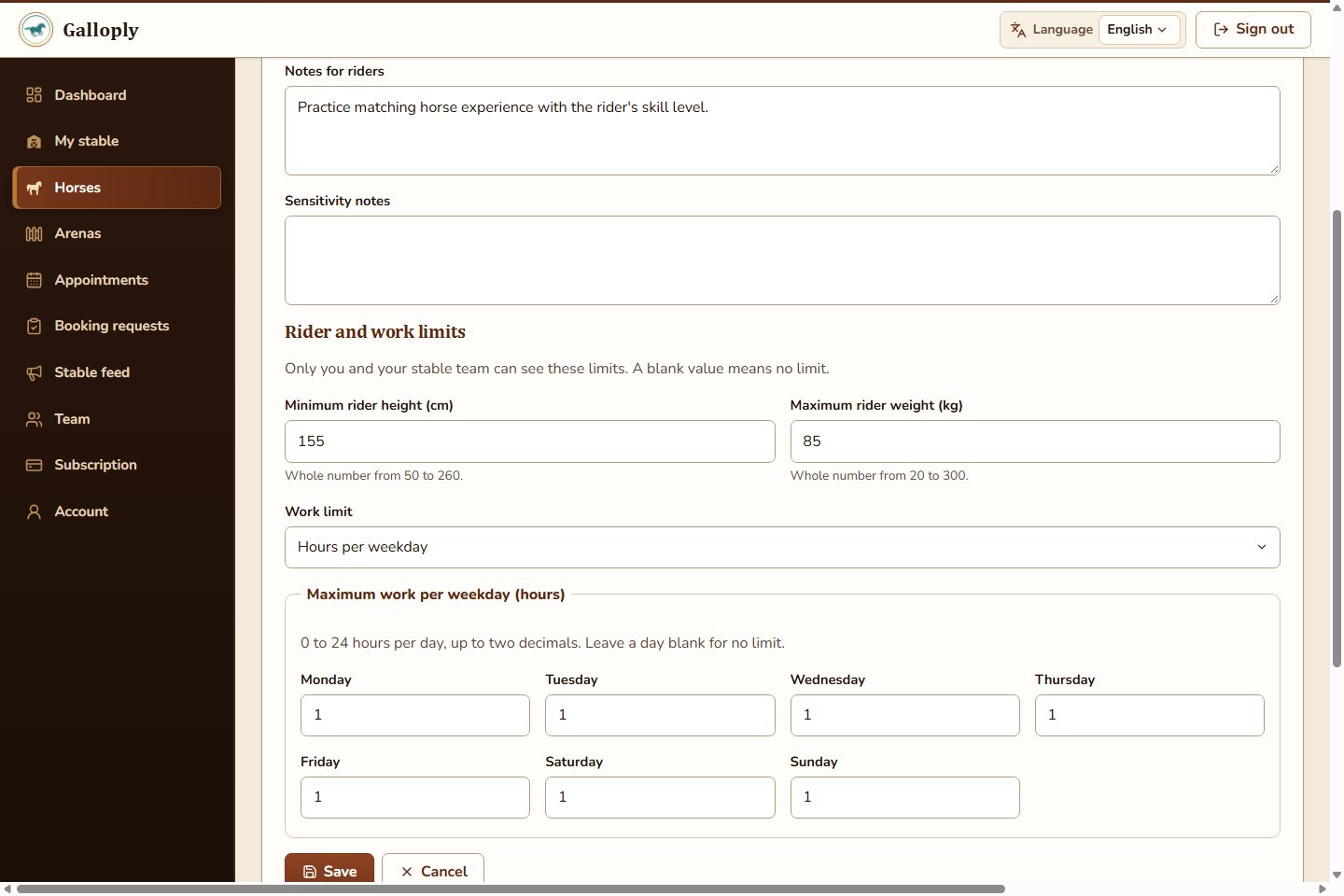
Every horse has a physical comfort zone shaped by its conformation, age, breed, and current fitness. Setting a maximum rider weight (in kilograms) and, for larger or stronger mounts, a minimum rider height (in centimeters) directly on the horse's profile turns an emotional judgment call into an objective rule. When you review a booking request, the system compares the rider's profile measurements against the horse's limits automatically.
2. Skill level and riding background
A horse that is a dream for an advanced rider can be overwhelming for a first-timer. In Galloply, each horse profile carries a difficulty level alongside its description, and each rider profile records the rider's skill level and riding experience. Seeing both side by side when assigning mounts ensures beginners get steady schoolmasters while experienced riders are paired with horses that match their ability.
3. Daily vs. weekly workload caps
Looking only at a single day's calendar hides cumulative fatigue, while looking only at a weekly total hides a brutal Saturday. That is why preventing overworked horses requires flexible workload rules. In Galloply, stable owners can configure either an overall weekly hour cap or individual weekday hour limits (Monday through Sunday) for each horse. All requested, accepted, and completed appointments count toward the horse's real workload across the week.
4. Including walk-in and phone riders in the same safety checks
Not every rider books through the app on day one. When a tourist calls by phone or a friend joins a trail ride at the last minute, leaving them off the digital schedule blinds your workload and safety checks. Galloply lets stable owners and authorized staff add custom riders without an account directly to an appointment—including optional height and weight—so every horse assignment still runs through the exact same limit and workload checks.
Respecting rider privacy while protecting horse welfare
One of the biggest reasons riders hesitate to share their height, weight, or date of birth online is privacy. Nobody wants their personal measurements visible to strangers browsing a public app.
Galloply solves this with field-level privacy controls:
- Riders (and parents managing family and child rider profiles) choose who can see their personal details—such as sharing height and weight only with stables on applied appointments.
- When a rider requests a place in your lesson, your stable receives the exact compatibility information needed to assign a safe horse, while other riders only see the rider's public nickname.
- Even when measurements are kept private, higher-tier stables still receive clear compatibility warnings if a selected horse's limits would be exceeded.
How to run stress-free horse assignments every week
- Set baseline limits for your herd once: Open each horse in your stable workspace and enter its maximum rider weight, optional minimum rider height, and either a weekly or per-weekday work-hour cap.
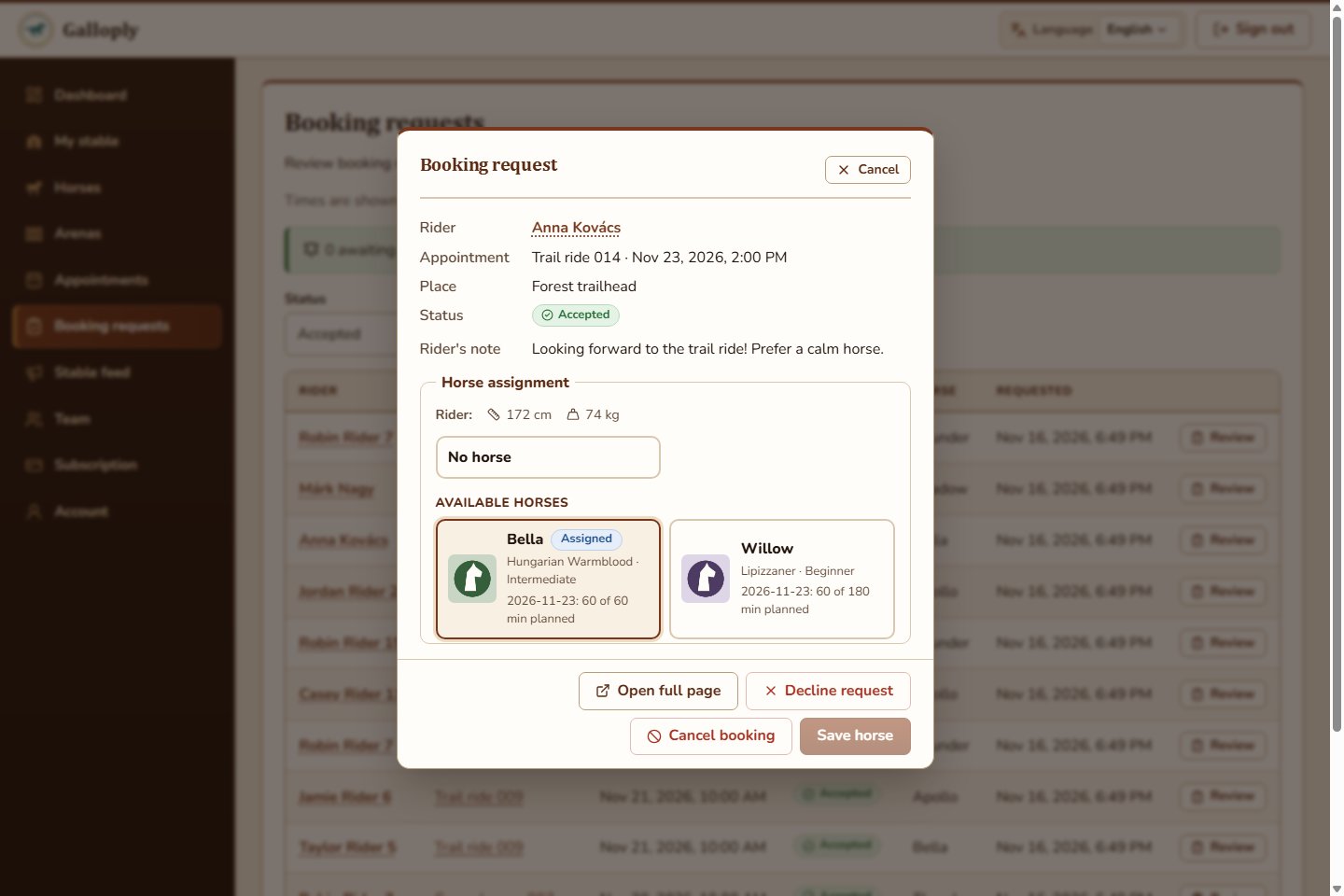
- Assign horses when approving booking requests: Use the booking review dialog to pick from horses that are free at that time. Available horses show their current and projected workload right on the card.
- Use bulk horse assignment for busy group lessons: Assign or swap horses across an entire group lesson in one view, with immediate conflict and limit feedback.
- Check "Needs attention" each morning: If a schedule change pushes a horse over its daily or weekly limit—or if an accepted rider still needs a horse assigned—the appointment automatically appears in your morning Needs attention queue.
What your stable gains
- Sounder, happier horses: Workload is spread evenly across your herd instead of falling on the same two "easy" horses.
- Zero awkward tack-room questions: Compatibility is checked quietly before the rider arrives at the barn.
- Faster team coordination: Even when you delegate scheduling to your stable team, your horse limits stay enforced on the server.
Ready to protect your horses and match every rider with confidence? Explore Galloply, set up your herd's limits in one stable dashboard, and make every lesson a better fit.